
When planning a new home, renovating an apartment, or specifying doors for a commercial project, most buyers focus on materials, finishes, and colors. However, one decision that significantly influences both functionality and interior design is often underestimated—the door opening system.
For homeowners, the right door can improve daily convenience and maximize usable space. For contractors, architects, distributors, and developers, selecting the appropriate door style can reduce installation challenges, improve project efficiency, and enhance the overall value of the property.
Among today’s most popular space-saving interior door solutions, pocket doors and barn doors stand out for their versatility, modern appearance, and ability to transform interior layouts. Although both eliminate the swing radius required by traditional hinged doors, they serve different design purposes and construction requirements.
Understanding how each system performs will help you make the right investment for every room and every project.
Modern residential and commercial buildings are increasingly designed around efficient space utilization and flexible room layouts.
Whether it’s a luxury villa, apartment complex, hotel, office, or renovation project, designers are moving away from conventional hinged doors in areas where space optimization and architectural aesthetics are priorities.
Among the available options, pocket doors and barn doors have become two of the most requested interior door systems worldwide.
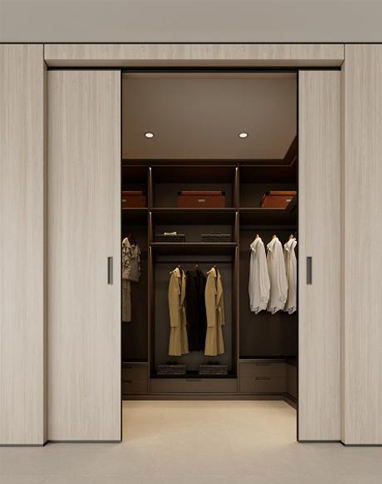
A pocket door is a sliding interior door that disappears completely into a concealed cavity inside the wall when opened.
Unlike traditional hinged doors, it requires no swing space and remains completely hidden when fully open, creating a clean and uninterrupted appearance.
Although pocket doors have existed for more than a century, advances in hardware technology have made them smoother, quieter, and more reliable than ever before.
Once closed, the door functions much like a conventional interior door while maintaining a minimalist appearance.
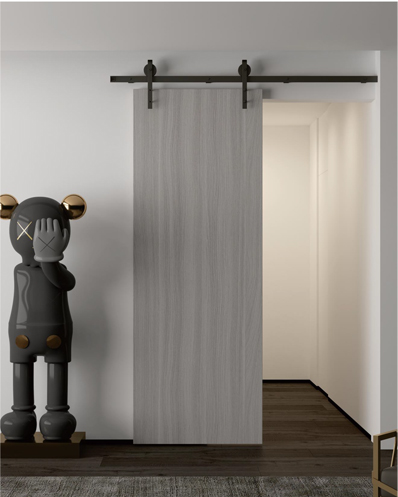
Barn doors operate on an exposed sliding track mounted to the face of the wall.
Originally designed for agricultural buildings, barn door systems have evolved into one of the most recognizable design features in modern residential interiors.
Instead of hiding the hardware, barn doors celebrate it.
Visible tracks, rollers, and decorative brackets become part of the overall design, allowing homeowners and designers to create distinctive architectural focal points.
Combined with wood, glass, painted, or flush door panels, barn doors offer remarkable design flexibility.
Both systems are designed to save space, but they achieve this in different ways.
Pocket doors completely disappear into the wall, allowing furniture and decorative elements to be placed directly beside the doorway.
Because there is no door swing, circulation becomes more efficient and usable floor area is maximized.
Barn doors eliminate the swing radius but require clear wall space beside the opening.
Rather than viewing this as a limitation, many designers use the exposed wall and sliding hardware as a decorative feature that enhances the overall interior.
Barn doors work particularly well in open-plan layouts where architectural character is part of the design concept.
From a project management perspective, installation complexity often influences product selection.
Pocket door systems require:
Because installation affects the wall structure, pocket doors are generally recommended for:
Professional installation ensures long-term reliability and smooth operation.
Barn doors offer a much simpler installation process.
For renovation projects, barn doors often reduce installation time and labor costs because existing walls remain largely untouched.
This simplicity makes them a popular choice for both residential upgrades and light commercial renovations.
Choosing between pocket and barn doors is not simply a functional decision—it is also a design statement.
Because the door disappears completely when opened, pocket doors allow surrounding architectural elements to become the visual focus.
They complement:
Almost any door material can be incorporated, including painted doors, natural wood veneers, glass panels, and flush doors.
Barn doors introduce texture, depth, and personality.
The exposed hardware creates an industrial, farmhouse, or contemporary appearance depending on the selected finish.
Pocket doors perform exceptionally well where space efficiency is critical.
For commercial projects, pocket doors also improve accessibility by minimizing door swing interference.
Barn doors excel where design impact is equally important as functionality.
Double barn door systems are particularly effective for large openings, creating a dramatic architectural feature while maintaining flexibility between connected spaces.
Today’s manufacturers can customize both pocket and barn door systems to meet diverse architectural requirements.
Available options include:
These customization possibilities allow distributors and project developers to create door solutions that match different market segments and design preferences.
Experienced distributors and contractors evaluate much more than appearance.
Rather than asking which system is universally better, professionals determine which solution best fits each project’s functional and architectural requirements.
Pocket doors and barn doors each offer unique advantages that extend far beyond aesthetics.
Pocket doors are the ideal choice for projects where maximizing floor space and maintaining clean architectural lines are priorities. Barn doors provide outstanding visual impact, easier installation, and greater decorative flexibility for both residential and commercial interiors.
As an experienced interior door manufacturer, we supply customized pocket door panels, barn doors, melamine door, WPC doors, painted doors, and complete interior door solutions for distributors, builders, hotels, apartments, schools, healthcare facilities, and commercial developments worldwide.
If you’re planning your next project and need professional advice on selecting the most suitable door system, our team is ready to provide customized recommendations, technical support, and reliable manufacturing solutions tailored to your market.